

Stand-up is a relatively young phenomenon. It originated in the US in the late nineteenth century. Mark Twain is considered to be the first famous wit of this genre. Bill Hicks made a significant contribution to the US stand-up art, and he became most famous after his death. Next on houstonski.
The beginning: Houston, nighttime escapes and the speech ban
The future wit was born on December 16, 1961, in Valdosta, Georgia. Bill was the third child in a devout Baptist family. His father worked as a department head at General Motors. Because of his job, his father was forced to move frequently, taking his family with him. The Hickses had to travel through Florida, Alabama and New Jersey until they settled in Houston. They managed to settle in the most prestigious Memorial District at the time.
Bill went to school here. Such a frequent change of educational institutions fostered extroversion in the future comedian’s character. He easily got along with people and quickly became the life of the party because of his extraordinary humor. If there were any conflicts, Bill smoothed them out with his witty jokes. He made friends very quickly, and got along best with Dwight Slade. They were united by their admiration for the work of comedian Woody Allen, who performed on The Tonight Show. They formed the duo Bill and Dwight and began working on their own comedy routines. At first, they were received with a bang in school programs, but the friends, having tasted fame and recognition, could no longer be satisfied with this success. They decided to try their hand at the local segment of the Jerry Lewis show.
The duo of Hicks and Slade passed the audition and were invited to star in the show. But this was prevented by Bill’s father, who was a strictly religious man and considered his son’s evening outings to be indecent. He forbade Bill to attend the event. But the young man did not listen to his father and began to sneak out the window in the evening to perform with a friend on the stage of the Comedy Workshop comedy club, receiving not only a fee but also an additional portion of adrenaline and fame.
B. Hicks won over the audience to the point that when his father found out about his nightly escapades, he strictly forbade him from performing. However, people called and visited Hicks Sr., trying to persuade him to let Bill continue, as the audience had grown attached to his jokes and eagerly awaited him. But his father was adamant. That was how the first stage of the comedy prodigy’s stand-up performances ended abruptly.

The test of loneliness
Bill had to accept his father’s decision. He stopped his nightly escapes but focused on music. With his great charisma, the young man was invited to join the rock band Stress. It was an ordinary group of teenagers who imagined themselves as rockers in the garage. This saved the guy from boredom and gave him the opportunity to break away from the stand-up that had already sunk so deeply into his soul.
His parents were forced to move to Little Rock, Arkansas. Bill managed to convince them to finish his high school education in Houston, as it was his last year. His parents were reluctant, but agreed to this, taking his word that he would not go to nightclubs. Bill was left alone in the big city.
Very quickly he forgot about his promise and resumed performing stand-up. His favorite stage this time was the Comix Annex. He made new friends and became a member of a group of comedians known as Texas Outlaw Comics. New friends, without parental supervision and a sense of adulthood, threw the young man into the whirlpool of adult entertainment: alcohol, drugs, women. He managed to finish school with difficulty. But when his parents persuaded him to go to college, Bill categorically stated that he would not do so, instead heading to LA to pursue a career as a comedy actor. It was brazen, and quite expectedly led to a break with his parents. However, the ambitious young comedian did not pay attention to this.
An unsuccessful trip to LA
LA was in no hurry to welcome B. Hicks. He immediately made many friends here. His old Houston friend Slade joined him. However, the young man did not achieve the desired quick success. Together with Slade, they began working on a script for a new TV project called The Suburbs. At first, the film industry was interested in it, but later the project was canceled. Bill tried his hand at filmmaking. He starred in a pilot TV series, but it was not completed either.
Since his parents did not bless his son’s choice, there was no one to finance him. To stay afloat, Hicks performs at various comedy venues in his usual stand-up style. He liked the Comedy Store club the most. Although his performances were laugh-out-loud funny, he couldn’t achieve Houston fame there. Disappointed, Hicks returns to his hometown.
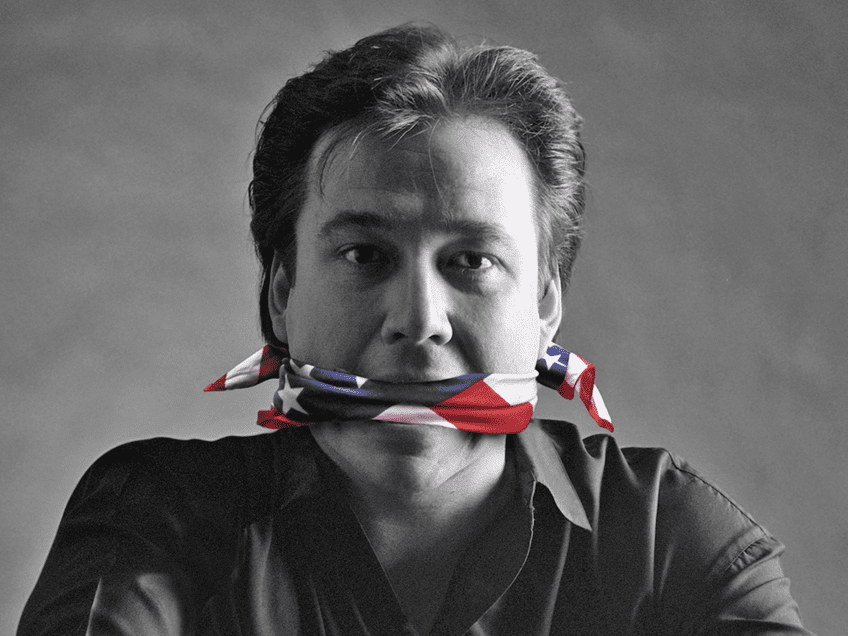
The king of comedians
In 1983, Hicks returned to Houston. Here he continued to perform at the already well-known Comix Annex. Very quickly he managed to regain his former glory as the king of comedians. He began to perform in the institutions of the state of Texas. Life went back to normal, success and fame returned and money started to flow.
This rhythm led to dramatic changes. To experiment, B. Hicks began to explore altered states of consciousness: meditation, hallucinogens and tanks of deprivation of feelings. This gradually led to the use of other drugs and alcohol. B. Hicks himself said:
“I would drink my own body weight in whiskey and snort my own body weight in cocaine.”
Unprepared performances, intoxication on stage, stupid jokes, big debts and canceled shows – this was the result of Hicks’ life. He realized this, but he couldn’t stop. His career as the king of comedians was going downhill. In the end, the man was thrown out of the club by the bartender, and Bill broke his leg falling. In the hospital, he regained some consciousness and came to the conclusion that he had to leave Houston, otherwise it was over.
The culmination of creativity
After giving up drugs and alcohol, Hicks moved to New York. During this period, from 1988 for the next 5 years, the comedian took up his work in earnest. He performed in various clubs, toured and released his first comedy album. Gradually, Hicks regained his fame as the king of stand-up.
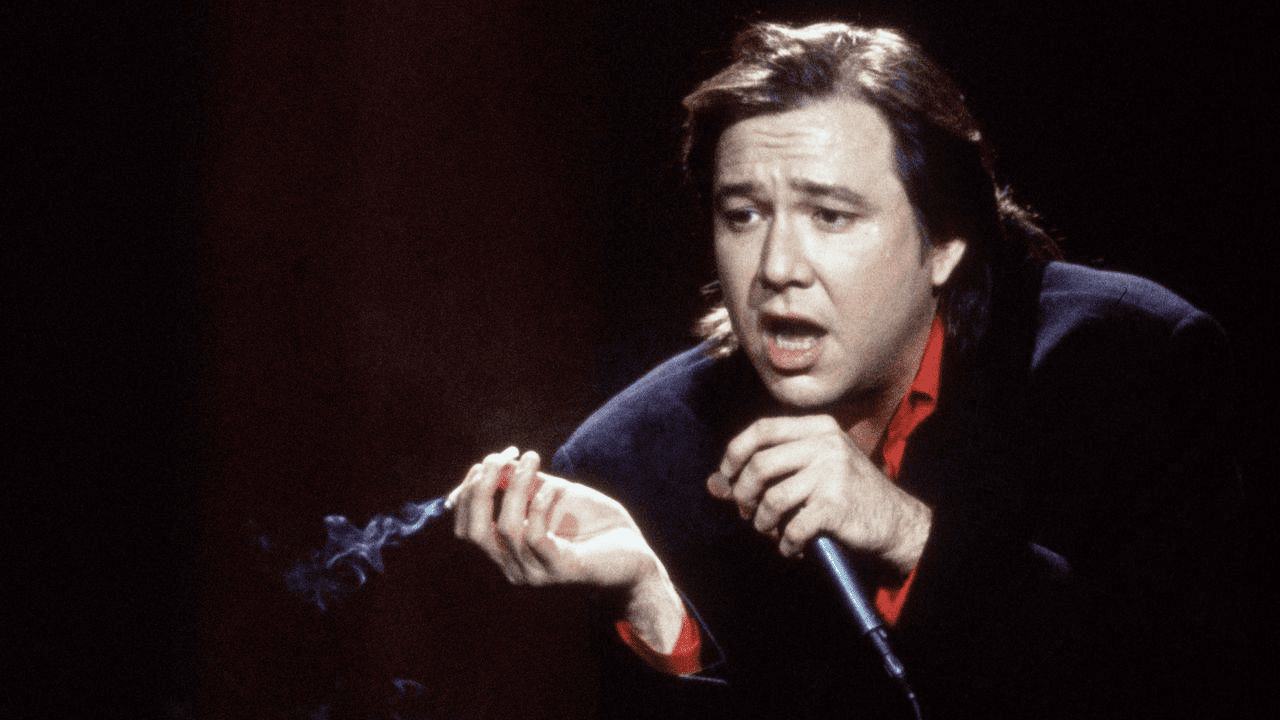
His speeches became more thoughtful and deeper, the topics were not just comic but acutely social. In his speeches, he touched on abortion, drugs, religion and conspiracy theories. His stage monologues were not just acting but the monologues of a philosopher who knows this world and sees what awaits it. He defended authenticity and cheerfully debunked mediocrity.
Advertising annoyed him the most. He even called the country the United States of Advertising, hinting that everything in this world revolves around money. He harshly criticized the fake piety of politicians, debunked their “good” intentions and ridiculed the hypocrisy of official religion. The man had a perfect command of the microphone and played brilliantly with facial expressions. Hicks never stopped, always walking around the stage, crouching down, or suddenly falling down. He also liked long pauses. The poignant themes and manner of performance could not but fascinate the audience.
A bolt from the blue
The comedian’s career was constantly growing. He began to actively tour the world. Most often he liked to visit the UK. In 1993, during a tour to Australia, he suddenly had a stomachache. Doctors diagnosed pancreatic cancer. Hicks began chemotherapy, but did not stop performing. In addition, he forbade anyone to tell anyone about his condition. The actor recorded two albums at a rapid pace, but they were not released until 1997. He actively appeared on various TV shows, but his condition was deteriorating. Eventually, after weighing everything, he decided to reunite with his family and moved to Arkansas. In 1994, the king of stand-up passed away.
After B. Hicks’ death, his popularity only increased. People began to watch all the surviving recordings en masse. Even David Letterman, the famous US showman who cut Hicks’ performance from his program, created a special program about him, inviting Bill’s mother and apologizing to her for it. He said:
“Hicks did to comedy what Dylan did to pop music; he took something that was looked down upon as a low art form and took it so seriously, put so much of his spirit into it, that he turned it into an effective vehicle for the Truth.”
Source:
- https://www.britannica.com/biography/Bill-Hicks%20
- https://www.grunge.com/657963/the-untold-truth-of-bill-hicks/%20
- https://www.theguardian.com/stage/2024/feb/26/bill-hicks-the-scorching-standup-who-thought-comedy-could-change-the-world%20
- https://www.yorkshirepost.co.uk/arts-and-culture/bill-hicks-much-more-than-just-another-anarchic-comedian-1972158